
Introduction
Search is changing faster than ever.
For years, businesses and content creators focused primarily on Search Engine Optimization (SEO) to make their websites visible on Google and other search engines. The objective was straightforward: understand what people search for, create useful content, optimize the website, build authority, and earn higher rankings.
But in 2026, search is no longer limited to a traditional list of blue links.
People are increasingly using AI-powered search experiences to ask questions, compare products, research services, discover brands, and get summarized answers. Tools such as ChatGPT Search and Google’s AI-powered search experiences can provide answers by finding and synthesizing information from multiple sources. OpenAI, for example, says ChatGPT Search can provide timely answers with links to relevant web sources.
This evolution has introduced a new concept for digital marketers: Generative Engine Optimization (GEO).
GEO focuses on improving the likelihood that a brand, website, product, expert, or piece of content will be surfaced, referenced, or represented accurately within AI-generated answers.
This raises an important question:
GEO vs SEO — which one should businesses focus on in 2026?
The short answer is that businesses should not think of GEO and SEO as competing strategies. Instead, they should understand how the two work together.
Google itself has emphasized that many of the fundamentals that have traditionally helped websites perform in Search also apply to its AI search experiences. Google recommends focusing on unique, valuable content created for people rather than trying to create content specifically to manipulate AI or search systems.
In this guide, we will explore the difference between GEO and SEO, how each works, why GEO matters in 2026, practical optimization strategies, and what the future of search could look like.
What Is SEO?
SEO stands for Search Engine Optimization.
SEO is the practice of improving a website and its content so that search engines can understand it and users can discover it through organic search results.
Google describes SEO as helping search engines understand content and helping users find a website through search.
For example, imagine someone searches:
“Best digital marketing institutes in Mumbai”
An SEO-focused website may create a detailed article targeting that search intent, optimize its headings and content, improve internal linking, build relevant authority, and ensure that search engines can crawl and understand the page.
The goal is to increase the website’s visibility in traditional search results.
Important Elements of SEO
A successful SEO strategy can involve several areas, including:
- Keyword research
- Search intent optimization
- On-page SEO
- Technical SEO
- Internal linking
- Backlinks and digital authority
- Helpful content
- Website performance
- Mobile usability
- Structured data
- Local SEO
- Content freshness
Google’s SEO documentation emphasizes making websites easier for search engines to crawl, index and understand.
However, modern SEO is much more than simply inserting keywords into an article.
Search engines increasingly attempt to understand the meaning, context, quality and usefulness of content. Google says its systems are designed to prioritize helpful, reliable, people-first information rather than content created primarily to manipulate rankings.
What Is GEO (Generative Engine Optimization)?
GEO stands for Generative Engine Optimization.
GEO is an emerging approach to optimizing content and brand information for AI-powered search and generative answer experiences.
Instead of focusing exclusively on the question:
“How can I rank higher in search results?”
GEO asks:
“How can I make my information useful, credible and discoverable enough to be included or referenced when an AI system generates an answer?”
This distinction is important.
Traditional search generally presents users with a collection of results. Generative search can synthesize information from multiple sources and present an answer in a conversational format.
For example, a user might ask an AI search system:
“What are the best digital marketing courses in Mumbai for beginners?”
Instead of receiving only a list of webpages, the user may receive a synthesized response discussing different options, factors to consider, course features, locations, pricing information and other relevant details.
For a business, being mentioned or cited in that answer can create a new form of digital visibility.
OpenAI’s documentation explains that ChatGPT Search can search the web, use current information and provide links to sources. Websites can also make themselves eligible for inclusion by allowing OAI-Searchbot to crawl their content.
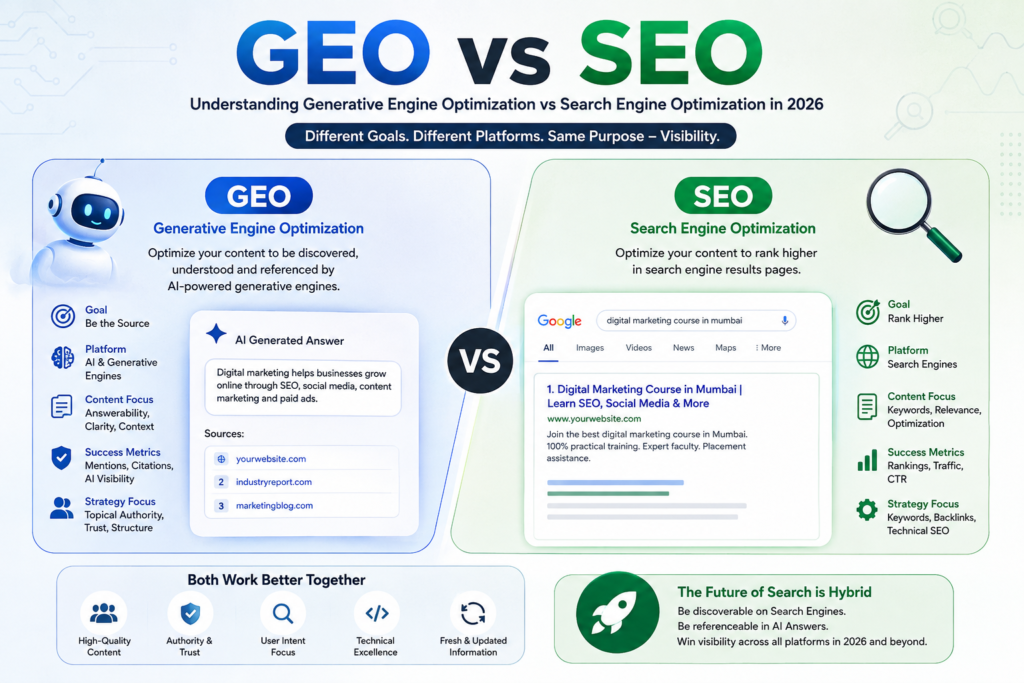
GEO vs SEO: Key Differences
Although GEO and SEO overlap significantly, their primary objectives and environments are different.
| Factor | SEO | GEO |
|---|---|---|
| Full form | Search Engine Optimization | Generative Engine Optimization |
| Primary goal | Improve organic search visibility | Improve visibility in AI-generated answers |
| Main environment | Traditional search engines | Generative AI/search experiences |
| User experience | Search results and webpages | Conversational answers and summaries |
| Keyword importance | Very important | Useful, but context is increasingly important |
| Content focus | Search intent and ranking relevance | Relevance, context, authority and answerability |
| Success indicators | Rankings, impressions, clicks and organic traffic | Mentions, citations, AI visibility and referral traffic |
| Authority | Backlinks, reputation and quality | Trust, authority, references and information quality |
| Optimization approach | Website + content + technical factors | Content + authority + clarity + discoverability |
| Long-term value | Organic search visibility | Visibility across AI-driven discovery |
One important point is that GEO does not mean abandoning SEO.
In fact, Google’s current guidance for AI search explicitly says that its foundational SEO practices remain relevant to success in its generative AI search experiences.
How Does GEO Work?
Generative AI systems can process information differently from traditional search result pages.
When someone asks a complex question, an AI-powered search experience may need to understand the intent behind the question, retrieve relevant information, evaluate sources and construct a useful response.
This means content needs to be more than keyword-focused.
It needs to be:
- Relevant
- Accurate
- Clear
- Well-structured
- Trustworthy
- Contextually useful
- Easy to interpret
1. Understand the User’s Question
GEO starts with understanding what users actually want to know.
For example:
Traditional keyword:
“digital marketing course Mumbai”
Conversational query:
“Which digital marketing course in Mumbai is suitable for someone with no marketing experience?”
The second query contains much more context.
A strong content strategy should address both the main topic and the questions users naturally ask around it.
2. Provide Direct Answers
AI-generated answers benefit from information that is easy to understand.
Instead of writing long paragraphs without clear answers, use:
- Descriptive headings
- Short paragraphs
- Definitions
- Lists
- Comparison tables
- FAQs
- Step-by-step explanations
This structure also makes content easier for human readers.
3. Build Authority
AI search systems need reliable information.
That makes credibility increasingly important.
Google’s guidance on helpful content emphasizes experience, expertise, authoritativeness and trustworthiness — commonly discussed as E-E-A-T. Google also states that trust is the most important aspect of E-E-A-T.
For a business website, authority can be supported by:
- Expert authors
- Author bios
- Original research
- First-hand experience
- Credible references
- Industry expertise
- High-quality backlinks
- Consistent brand information
4. Make Information Verifiable
If your article contains statistics, research findings or factual claims, support them with reliable sources.
This is particularly important for informational content where readers need confidence in the information.
Why Does GEO Matter in 2026?
GEO matters because the way people discover information is evolving.
Search is becoming increasingly conversational and AI-assisted.
Instead of performing several searches such as:
- What is digital marketing?
- Which digital marketing course is best?
- What is the course fee?
- Which institute is near me?
- Which course is best for beginners?
A user may increasingly ask an AI system one comprehensive question and expect a synthesized response.
That changes the discovery journey.
A brand may no longer compete only for a position on a search results page. It may also compete to become one of the sources considered when an AI system constructs an answer.
Google has recognized this evolution through AI experiences such as AI Overviews and AI Mode. In June 2026, Google also announced new Search Console reporting designed to provide visibility into impressions from generative AI features in Search, including AI Overviews and AI Mode, initially rolling out to a subset of websites.
This is a significant development for marketers because it shows that visibility within generative search is becoming something website owners can increasingly monitor.
Why SEO Still Matters in 2026
With all the attention around GEO, some marketers may wonder whether SEO is becoming obsolete.
It isn’t.
SEO remains an essential foundation for digital visibility.
Google’s own guidance says the fundamentals that have historically helped websites perform in Search continue to apply to its AI search experiences.
A technically poor website, weak content structure, inaccessible pages and low-quality information are unlikely to become strong digital assets simply because a business starts talking about GEO.
Strong SEO still helps search engines:
- Discover your content
- Crawl your pages
- Understand your website
- Identify relevant topics
- Connect pages with search queries
- Evaluate content quality
Google’s Search Essentials also outline technical requirements, spam policies and best practices that can help content become eligible to appear in Search.
Therefore, the smarter strategy in 2026 is:
SEO + GEO rather than SEO vs GEO.
GEO vs SEO: Which One Is Better?
There isn’t a universal winner.
The right answer depends on your business goals.
If your main goal is to increase organic traffic from traditional search, SEO should remain a major priority.
If your audience increasingly uses AI-powered search and conversational discovery, GEO should become part of your content strategy.
For most businesses, combining both is the strongest approach.
Think of it this way:
SEO helps people discover your website through search.
GEO helps your information become useful and discoverable within generative search experiences.
The two strategies can reinforce one another.
How to Create a GEO-Friendly Content Strategy
If you want to prepare your website for AI-powered search, start with the fundamentals rather than chasing shortcuts.
1. Answer Real Questions
Research the questions your target audience actually asks.
For example, a digital marketing website could create content around:
- What is digital marketing?
- Is digital marketing a good career in 2026?
- How much does a digital marketing course cost?
- What skills are required for digital marketing?
- What is SEO?
- What is GEO?
- How does AI affect digital marketing?
Answer each question comprehensively.
2. Create Topical Authority
Don’t publish one article about a topic and stop.
Build a content cluster.
For example, if your primary topic is digital marketing, you could publish articles about:
- SEO
- Social media marketing
- Performance marketing
- Email marketing
- Content marketing
- AI marketing
- GEO
- Google Ads
- Analytics
- Digital marketing careers
Then connect these articles through relevant internal links.
This helps users navigate your website and creates a stronger topical structure.
3. Add Original Insights
One of the biggest weaknesses of generic online content is that it simply repeats information already available elsewhere.
Google recommends creating unique, valuable content that provides something useful to visitors rather than producing commodity content.
Add:
- Original research
- Expert opinions
- Case studies
- Examples
- Surveys
- First-hand observations
- Screenshots
- Industry data
- Practical experiences
The more genuine value your content provides, the stronger your content asset can become.
4. Use Clear Formatting
Make content easy to scan.
Use:
- H2 and H3 headings
- Bullet points
- Numbered lists
- Tables
- Short paragraphs
- FAQs
- Definitions
- Examples
Clear formatting benefits readers and makes important information easier to identify.
5. Demonstrate Expertise
Don’t hide the person behind your content.
Consider adding:
- Author name
- Author biography
- Professional experience
- Relevant credentials
- Editorial information
- Sources and references
Google specifically recommends making it clear who created content and providing appropriate bylines.
SEO Strategies That Also Support GEO
One of the biggest misconceptions about GEO is that businesses need to throw away their existing SEO strategies.
They don’t.
Many established SEO practices remain useful.
Keyword Research
Keywords help you understand what your audience is searching for.
However, don’t focus exclusively on exact-match keywords.
Also consider:
- Questions
- Related topics
- Synonyms
- Search intent
- Conversational queries
- Problem-based searches
Internal Linking
Connect related content throughout your website.
For example:
GEO Guide → AI SEO → SEO Trends → Digital Marketing Trends
This helps users discover related information and gives your website a logical content structure.
Technical SEO
Make sure search engines can access and understand your website.
Important areas include:
- Crawlability
- Indexability
- Mobile usability
- Website security
- Page performance
- Clean site architecture
Google’s developer guidance specifically highlights making websites secure, fast, accessible and usable across devices.
High-Quality Backlinks
Relevant links from reputable websites can help strengthen your website’s authority.
However, link building should focus on quality and relevance rather than simply collecting a large number of links.
Helpful Content
Perhaps the most important shared principle between SEO and GEO is content quality.
Google recommends people-first content that provides substantial, comprehensive and original value.
How to Optimize Content for AI Search
There is no guaranteed formula that will make an AI system mention a particular website.
Be cautious of anyone promising guaranteed GEO rankings.
Instead, focus on making your content genuinely useful and easy to understand.
Use Question-Based Headings
For example:
What is GEO?
How does GEO work?
Is GEO replacing SEO?
How can businesses optimize for AI search?
These headings directly reflect common informational needs.
Give Concise Answers First
Start sections with a clear answer and then provide additional context.
For example:
GEO is the practice of optimizing information so it has a stronger chance of being discovered, understood and referenced in generative AI search experiences.
Then explain the concept in greater detail.
Include Reliable Evidence
Use credible statistics, studies and references where appropriate.
Avoid publishing unsupported claims simply because they sound impressive.
Keep Information Updated
AI search and traditional search are evolving rapidly.
Review important articles periodically and update outdated information.
However, don’t simply change the publication date without making meaningful improvements. Google explicitly warns against changing dates merely to make content appear fresh when the content has not substantially changed.
GEO for Local Businesses
Local businesses have an interesting opportunity with AI search.
Imagine someone asks:
“What are the best digital marketing institutes near me?”
Or:
“Which digital marketing agency in Mumbai specializes in SEO?”
A business needs accurate, consistent and useful information across its digital presence.
A local GEO strategy can include:
- Complete business information
- Consistent name, address and contact details
- Location-specific website content
- Service pages
- Customer reviews
- Frequently asked questions
- Local case studies
- Relevant local backlinks
- Updated business profiles
For example, a Mumbai-based digital marketing institute could publish detailed resources about:
“Best Digital Marketing Courses in Mumbai”
and answer questions about:
- Course duration
- Fees
- Modules
- Certifications
- Career opportunities
- Placement support
- Locations
- Beginner suitability
This creates a useful information ecosystem around the brand.
GEO for E-Commerce Businesses
E-commerce brands can also benefit from creating content designed around product discovery.
Instead of publishing only product pages, businesses can create:
- Product comparisons
- Buying guides
- Product FAQs
- Reviews
- How-to guides
- Use-case content
- Product specifications
- Category guides
For example, instead of only targeting:
“Best running shoes”
a brand could create a detailed guide addressing:
“How to choose running shoes for beginners?”
Then explain:
- Cushioning
- Fit
- Running surface
- Shoe type
- Durability
- Price considerations
This provides useful context around the product rather than simply attempting to rank a commercial page.
Common GEO Mistakes to Avoid
GEO is still an emerging area, so misinformation and exaggerated claims are common.
Here are some mistakes to avoid.
1. Writing Only for AI
Your first audience should remain people.
Google explicitly recommends creating people-first content rather than content primarily designed to manipulate search systems.
2. Keyword Stuffing
Adding the same keyword repeatedly doesn’t automatically improve GEO or SEO.
Write naturally.
3. Publishing Generic AI Content
Using AI to assist with research, ideation or drafting can be useful, but simply publishing large quantities of generic content is not a strong strategy.
Your content should add original value.
4. Using Unverified Statistics
Never add statistics simply because they make an article look authoritative.
Verify important claims using reputable sources.
5. Ignoring SEO
GEO isn’t a replacement for technical SEO, crawlability, indexability and good website architecture.
6. Chasing “GEO Hacks”
There is no magic trick that guarantees inclusion in AI-generated answers.
AI systems can change their retrieval and ranking mechanisms, and individual responses can vary.
Focus on fundamentals.
How to Measure GEO Success
Measuring GEO is still developing, but marketers can monitor several useful indicators.
AI Mentions
Track whether your brand appears when users ask relevant questions in AI search platforms.
Citations
Check whether AI-generated answers reference your website or content.
Referral Traffic
Monitor traffic coming from AI-powered platforms where referral data is available.
Brand Searches
An increase in branded searches may indicate that more people are discovering your business through new channels.
Organic Performance
Continue monitoring traditional SEO metrics such as:
- Organic clicks
- Impressions
- Rankings
- CTR
- Conversions
Google’s June 2026 announcement of generative AI performance reporting in Search Console is particularly notable because it introduces dedicated visibility reporting for generative AI features, initially for a subset of sites.
This suggests that measuring AI visibility is moving toward becoming a more formal part of search performance analysis.
The Future of GEO and SEO
So, will GEO replace SEO?
Probably not.
A more realistic future is that SEO will expand into a broader search visibility discipline.
People may discover brands through:
- Google Search
- AI search
- ChatGPT
- Social media
- YouTube
- Voice assistants
- Maps
- Online communities
- Other AI-powered discovery tools
This means marketers need to think beyond one search engine.
The future could increasingly be about being discoverable wherever people search for information.
That is why the idea of Search Everywhere Optimization is becoming increasingly relevant.
Instead of asking:
“How do I rank number one on Google?”
marketers may increasingly ask:
“How do I make my brand the most useful and trusted answer across search and AI discovery platforms?”
That is a much broader challenge.
GEO vs SEO: Frequently Asked Questions
What is the difference between GEO and SEO?
SEO focuses primarily on improving visibility in traditional search engine results, while GEO focuses on improving the likelihood that information will be surfaced or referenced within generative AI search experiences.
Is GEO replacing SEO?
No. GEO should generally be viewed as complementary to SEO. Google’s own guidance indicates that SEO fundamentals remain relevant to its AI search experiences.
Is GEO important for businesses in 2026?
Yes, particularly for businesses whose customers increasingly use AI-powered tools for research, comparisons and recommendations.
How do I optimize my website for GEO?
Start with strong SEO fundamentals, then focus on original, authoritative, accurate and clearly structured content that directly answers the questions your audience asks.
Can SEO and GEO work together?
Absolutely. Strong technical SEO, helpful content, topical authority and credible information can support visibility across both traditional and generative search experiences.
Does GEO improve Google rankings?
There is no separate guaranteed “GEO ranking” mechanism that automatically improves traditional rankings. Google has stated that its existing foundational guidance remains relevant to AI search experiences.
What are the best GEO strategies?
The strongest approach is to create people-first content, demonstrate expertise, provide original value, answer questions clearly, maintain accurate information, build authority and ensure your website is technically accessible.
Conclusion
The debate around GEO vs SEO is really a discussion about how search itself is evolving.
SEO remains fundamental to online visibility. Businesses still need technically accessible websites, useful content, relevant search intent, strong site architecture and trustworthy information.
At the same time, generative AI is creating new ways for people to discover information.
Instead of simply scanning search results, users can increasingly ask conversational questions and receive synthesized answers with references to web sources. ChatGPT Search, Google’s AI search experiences and other emerging technologies demonstrate how search is becoming more conversational and answer-oriented.
For marketers, the lesson is clear:
Don’t choose GEO over SEO. Build a strategy that supports both.
Create content for people first. Make it original, useful, trustworthy and easy to understand. Follow sound SEO fundamentals, establish topical authority and provide information that genuinely answers your audience’s questions.
As search continues to evolve in 2026 and beyond, the brands that succeed will not necessarily be those that chase every new optimization acronym.
They will be the brands that consistently provide credible answers, valuable experiences and information people—and increasingly AI-powered search systems—can understand and trust.
GEO and SEO are not enemies. They are two parts of the modern search visibility strategy.