
Introduction
Digital marketing has never stood still, but 2026 is bringing some of the biggest changes marketers have seen in years.
Artificial intelligence is becoming part of everyday marketing workflows. Search is evolving beyond traditional Google results. Social media platforms are increasingly functioning as discovery and shopping channels. Customers expect personalized experiences, while businesses are under greater pressure to demonstrate measurable returns from their marketing investments.
According to HubSpot’s 2026 State of Marketing report, AI, personalization, automation, SEO changes and content repurposing are among the major areas marketers are focusing on this year. The report is based on research involving more than 1,500 marketers globally.
At the same time, Google is continuing to develop AI-powered search experiences. Its current guidance makes an important point: traditional SEO fundamentals remain relevant even as websites adapt their content for generative AI features.
For marketers, this means one thing:
The goal isn’t simply to follow every new trend. It’s to understand which changes matter and learn how to use them strategically.
In this article, we’ll explore the top 10 digital marketing trends in 2026 that marketers, businesses, entrepreneurs and content creators should know to stay competitive.
Why Digital Marketing Trends Matter in 2026
Before looking at individual trends, it’s important to understand why the digital marketing landscape is changing so quickly.
Consumer behavior has become more fragmented. Someone might discover a product through Instagram, research it on YouTube, ask an AI tool for recommendations, visit a company’s website and finally make a purchase through a social platform.
This means businesses can no longer think about marketing as a collection of completely separate channels.
SEO, social media, content marketing, email, paid advertising, AI and customer data increasingly work together.
The 2026 marketing landscape can be summarized in four words:
AI + Search + Content + Customer Experience.
Marketers who understand how these areas connect will be better positioned to adapt as platforms and consumer expectations continue to change.
Let’s explore the trends shaping digital marketing in 2026.
1. AI-Powered Digital Marketing
Artificial intelligence is no longer just an experimental technology for marketers. It has become part of everyday marketing operations.
From brainstorming campaign ideas to creating content, analyzing customer data and optimizing advertising campaigns, AI is helping marketing teams work faster and at greater scale.
HubSpot’s 2026 research found that 86.4% of marketing teams surveyed use AI in at least some marketing activities. Common applications include content creation, media creation, advertising optimization, administrative automation, learning, brainstorming and strategic planning.
How marketers are using AI
AI can help marketers with:
- Content ideation
- Blog outlines and drafts
- Social media content
- Email personalization
- Ad copy variations
- Customer segmentation
- Campaign analysis
- Marketing automation
- Predictive insights
- Chatbots and customer support
For example, instead of spending hours brainstorming 20 social media ideas, a marketer can use AI to generate initial concepts and then apply human creativity and industry knowledge to improve them.
However, AI should not mean producing large amounts of generic content.
The competitive advantage will come from using AI for efficiency while maintaining human expertise, originality, creativity and quality.
What marketers should do
Start by identifying repetitive marketing tasks that can be assisted by AI.
Don’t try to automate everything at once.
Use AI as a marketing assistant rather than treating it as a complete replacement for strategic thinking.
2. GEO and AI Search Optimization
One of the biggest changes in search marketing is the rise of generative AI search experiences.
You may already know about SEO, or Search Engine Optimization.
Now marketers are increasingly discussing concepts such as GEO — Generative Engine Optimization and AEO — Answer Engine Optimization.
The basic idea is to make your content useful and discoverable in AI-powered search experiences.
Google itself introduced updated guidance in 2026 explaining how website owners can optimize for generative AI features in Search. Importantly, Google says its existing SEO best practices continue to be relevant for these AI search experiences.
Why GEO matters
Traditional search often gives users a list of links.
AI-powered search can instead provide a synthesized response and may reference or cite information from different websites.
This changes the way marketers think about visibility.
Instead of asking only:
“How can I rank #1?”
marketers increasingly need to ask:
“How can I become a reliable source that search and AI systems can understand and reference?”
How to prepare for AI search
Focus on:
- Original and useful information
- Clear answers to customer questions
- Strong topical coverage
- Authoritative sources
- First-hand experience
- Well-structured content
- Relevant examples and data
- Clear website architecture
- Strong traditional SEO foundations
The key takeaway is that GEO does not replace SEO.
In fact, strong SEO fundamentals remain an important foundation for visibility in evolving search experiences.
3. The Evolution of SEO
SEO is not disappearing in 2026.
It is evolving.
Google’s current documentation specifically emphasizes that its generative AI search features are built on core Search quality and ranking systems.
That means marketers still need to pay attention to fundamentals such as:
- Search intent
- Technical SEO
- Website performance
- Internal linking
- Useful content
- Structured information
- Relevant keywords
- Quality backlinks
- User experience
But modern SEO goes beyond inserting keywords into an article.
Imagine two websites targeting the same keyword.
Website A writes a 1,500-word article that repeats the keyword dozens of times.
Website B provides original examples, expert insights, useful statistics, visuals, FAQs and practical solutions.
Website B is more likely to provide genuine value to the reader.
That is the direction modern SEO is moving toward.
Search intent is becoming increasingly important
Marketers need to understand what the user actually wants.
Someone searching:
“digital marketing”
could be looking for a definition.
Someone searching:
“best digital marketing course in Mumbai”
has a very different intent.
Understanding this difference helps marketers create content that answers the right question at the right stage of the customer journey.
4. Short-Form Video Marketing
If there is one content format marketers should continue paying attention to in 2026, it is short-form video.
Instagram Reels, YouTube Shorts, TikTok and short video formats across other platforms have made video a major part of digital content strategies.
Sprout Social’s 2026 research describes video as a continuing priority across major social networks, while its video research reports that short-form video remains a particularly important format for marketers.
Why short-form video works
Short videos can:
- Capture attention quickly
- Explain concepts visually
- Build brand awareness
- Demonstrate products
- Educate audiences
- Generate engagement
- Drive traffic
- Support personal branding
For example, a digital marketing professional could turn one blog article into several videos:
Blog:
“10 SEO Mistakes Beginners Should Avoid”
Video 1: Keyword stuffing
Video 2: Ignoring search intent
Video 3: Poor internal linking
Video 4: Duplicate content
This is where content repurposing becomes powerful.
One piece of long-form content can become:
Blog → Reel → YouTube Short → LinkedIn post → Carousel → Email
Instead of constantly creating from scratch, marketers can build a content ecosystem.
5. Personalization and Hyper-Personalized Marketing
Consumers don’t want to feel like they’re receiving the same message as everyone else.
They want content and experiences that are relevant to their interests, needs and stage in the buying journey.
This is where personalization becomes important.
According to HubSpot’s 2026 marketing research, using AI to create personalized content was the top trend identified by marketers surveyed, while 93.2% said personalized or segmented experiences had led to more leads and purchases.
Examples of personalization
A business can personalize:
- Email campaigns
- Product recommendations
- Website content
- Offers
- Advertisements
- Landing pages
- Customer journeys
- Social media communication
For example, an online fashion store might show different recommendations based on a customer’s browsing behavior.
A digital marketing agency might send different emails to:
- Beginners
- Small business owners
- E-commerce brands
- Marketing managers
The message becomes more relevant because the audience is segmented.
The role of AI
AI makes personalization easier to scale.
Instead of manually creating dozens of variations, marketers can use AI to assist with audience segmentation and content variations.
But personalization also requires responsible data usage.
Businesses should be transparent about how customer information is collected and used.
6. Social Media Is Becoming a Search Engine
For years, Google was the obvious destination for online searches.
But that’s changing.
People increasingly use social platforms to discover products, services, creators, reviews and educational content.
Sprout Social’s 2026 social media research highlights the growing role of social platforms in product discovery and the importance of social search.
Someone looking for:
“Best cafés in Mumbai”
might search on Instagram.
Someone interested in:
“How to edit a Reel”
might search on YouTube.
Someone looking for:
“Digital marketing career tips”
might search on LinkedIn or YouTube.
This creates a new opportunity for marketers:
Social SEO
Social SEO involves optimizing social content so that it can be discovered through platform searches.
This can include:
- Using relevant keywords
- Writing descriptive captions
- Optimizing video titles
- Adding relevant hashtags
- Creating searchable content
- Optimizing profiles
- Answering common questions
Google is also expanding how Search Console can provide insights into social and video content performance. In July 2026, Google announced that its platform properties became globally available for tracking eligible social and video content performance in Google Search, Discover and Google News.
The lesson is simple:
Don’t create content only for feeds. Create content that people can find.
7. Influencer and Creator Marketing
Influencer marketing has evolved significantly.
Brands are increasingly moving away from the idea that the creator with the largest follower count is automatically the best choice.
In 2026, relevance, authenticity, engagement and measurable results matter.
Sprout Social’s 2026 influencer research found that only 17% of consumers surveyed check a creator’s follower count before deciding to engage, while subject relevance and content style matter more to audiences.
This is particularly important for smaller businesses.
A niche creator with 20,000 highly relevant followers may produce better results than a celebrity with millions of followers but little connection to the product category.
Creator marketing can include
- Product reviews
- Tutorials
- Short-form videos
- User-generated content
- Brand collaborations
- Live streams
- Educational content
- Affiliate marketing
The most effective partnerships are usually those where the creator understands the audience and can communicate naturally.
Brands should also measure more than likes.
Important metrics can include:
- Engagement
- Website visits
- Leads
- Sales
- Conversions
- Cost per acquisition
- Revenue generated
Influencer marketing is becoming less about “How many followers do you have?”
and more about:
“Can you influence the right audience?”
8. First-Party Data and Privacy-Focused Marketing
Data has always been important in digital marketing.
But marketers are becoming increasingly conscious of privacy, consent and data ownership.
This makes first-party data particularly valuable.
First-party data is information a business collects directly from its audience through legitimate interactions, such as:
- Website activity
- Email subscriptions
- Purchases
- Customer accounts
- Surveys
- Loyalty programs
- Direct interactions
Instead of depending entirely on external platforms, businesses can develop direct relationships with their customers.
Why first-party data matters
It can help businesses understand:
- What customers are interested in
- What products they consider
- What content they consume
- What offers they respond to
- Where they are in the buying journey
But businesses need to collect and use this information responsibly.
Trust is becoming a marketing asset.
A customer who trusts a company is more likely to engage with its content, subscribe to its communications and continue the relationship.
9. Marketing Automation and Conversational Marketing
Automation is another major trend shaping digital marketing in 2026.
HubSpot’s 2026 research identifies leveraging automation as one of the leading marketing trends reported by marketers.
Automation allows marketers to handle repetitive tasks without manually performing every action.
Examples include:
- Welcome emails
- Lead nurturing
- Abandoned-cart emails
- Customer follow-ups
- Appointment reminders
- Lead scoring
- Audience segmentation
- Chatbot conversations
- Campaign reporting
Imagine someone downloads an e-book from your website.
Instead of manually contacting that person, an automated journey could:
Day 1: Send the e-book
Day 3: Send a related educational article
Day 6: Share a useful case study
Day 10: Introduce a relevant service
This creates a structured customer journey.
Conversational marketing
Chatbots and AI assistants are also changing how businesses communicate with customers.
Customers can get answers faster without waiting for a human representative for every basic question.
However, automation should not make a brand feel robotic.
The best strategy combines:
Automation for efficiency + humans for empathy and complex decisions.
10. Data-Driven Marketing and Predictive Analytics
Marketing decisions based purely on assumptions are becoming less effective.
Modern marketers need to understand what their data is telling them.
Data-driven marketing means using measurable information to improve decisions.
Instead of saying:
“I think this campaign worked.”
you should be able to ask:
- How many people saw it?
- How many clicked?
- How many converted?
- What was the acquisition cost?
- Which audience performed best?
- Which channel generated revenue?
- What should we change next time?
Important marketing metrics
Depending on the business, marketers can track:
- Website traffic
- Engagement rate
- Conversion rate
- Cost per lead
- Customer acquisition cost
- Return on ad spend
- Customer lifetime value
- Email open and click rates
- Organic search performance
Predictive analytics takes this further by helping marketers identify patterns and make better-informed forecasts.
AI can assist with analyzing large amounts of data, identifying trends and supporting forecasting.
The important point is that data should lead to action, not just dashboards full of numbers.
Bonus Trend: The Rise of Personal Branding
Personal branding deserves an honorable mention in 2026.
Customers increasingly want to know the people behind businesses and organizations.
This is particularly important on platforms such as LinkedIn, Instagram and YouTube.
A strong personal brand can help professionals:
- Build authority
- Develop trust
- Attract opportunities
- Generate leads
- Grow a network
- Showcase expertise
For example, a digital marketer can regularly publish:
- SEO tips
- Marketing case studies
- Industry insights
- Personal lessons
- Campaign breakdowns
- Educational videos
Over time, consistent content can transform an individual from simply being another professional online into a recognizable subject-matter expert.
How These Digital Marketing Trends Work Together
The most important lesson is that these trends shouldn’t be treated as isolated strategies.
They work best when combined.
Consider this example:
A digital marketing agency creates an in-depth blog about SEO trends in 2026.
It then uses AI to help identify content gaps and create variations.
The article is optimized using SEO fundamentals and structured so that it can be useful in AI-powered search.
The agency turns the article into short-form videos.
Those videos are optimized for social search.
A LinkedIn post drives traffic back to the article.
Visitors who subscribe to the website become part of the company’s first-party audience.
An automated email sequence nurtures those leads.
Analytics then show which content and channels generated the most conversions.
That’s a complete digital marketing ecosystem.
Content → SEO/GEO → Social → Personalization → Automation → Data → Conversion
This integrated approach is much more powerful than chasing individual trends.
How Businesses Can Prepare for Digital Marketing in 2026
You don’t need to adopt every trend immediately.
Instead, follow a structured approach.
Step 1: Audit your existing strategy
Look at your website, SEO, social media, email marketing and paid campaigns.
Identify what’s working and what’s not.
Step 2: Understand your audience
Research their problems, search behavior, content preferences and buying journey.
Step 3: Experiment with AI
Start with simple tasks such as brainstorming, research organization, content repurposing and analysis.
Step 4: Strengthen SEO
Focus on search intent, helpful content, technical foundations, internal linking and authority.
Step 5: Prepare for AI search
Create original, trustworthy and useful content that clearly answers your audience’s questions.
Step 6: Invest in video
Start with short educational videos instead of worrying about expensive production.
Step 7: Build your first-party audience
Encourage visitors to subscribe to newsletters, create accounts or engage directly with your brand where appropriate.
Step 8: Automate repetitive tasks
Identify tasks that consume time but don’t require constant human decision-making.
Step 9: Measure results
Choose KPIs connected to actual business objectives.
Step 10: Keep learning
Digital marketing changes constantly.
A strategy that works today may need adjustment six months from now.
Common Digital Marketing Mistakes to Avoid in 2026
Following trends can be useful, but blindly following them can create problems.
1. Using AI without human review
AI-generated content can still contain errors, generic ideas or inaccurate information.
2. Ignoring traditional SEO
The rise of AI search doesn’t mean SEO fundamentals are obsolete. Google’s own guidance emphasizes their continued relevance.
3. Chasing every social media trend
Not every platform or trend is relevant to every business.
4. Focusing only on vanity metrics
Likes and followers are useful indicators, but leads, conversions and revenue may matter more.
5. Creating content without a strategy
Publishing every day doesn’t guarantee results.
6. Ignoring customer experience
Marketing should not end after the click.
The landing page, checkout process, customer support and follow-up all influence the final outcome.
7. Forgetting the human element
Technology can improve marketing efficiency, but trust, creativity, empathy and storytelling remain important.
The Future of Digital Marketing
The future of digital marketing isn’t simply about using more technology.
It’s about using technology more intelligently.
AI will continue to influence content, advertising, analytics, personalization and customer experiences.
Search will continue evolving.
Social platforms will continue becoming important discovery channels.
Video will remain a powerful format.
Businesses will collect and use first-party data more strategically.
And customers will continue expecting brands to provide useful, relevant and authentic experiences.
The marketers who succeed won’t necessarily be the ones who use the most tools.
They’ll be the ones who understand why they’re using those tools.
Conclusion
The digital marketing landscape in 2026 is being shaped by several major forces: artificial intelligence, evolving search behavior, personalization, short-form video, social discovery, creator marketing, automation, privacy and data-driven decision-making.
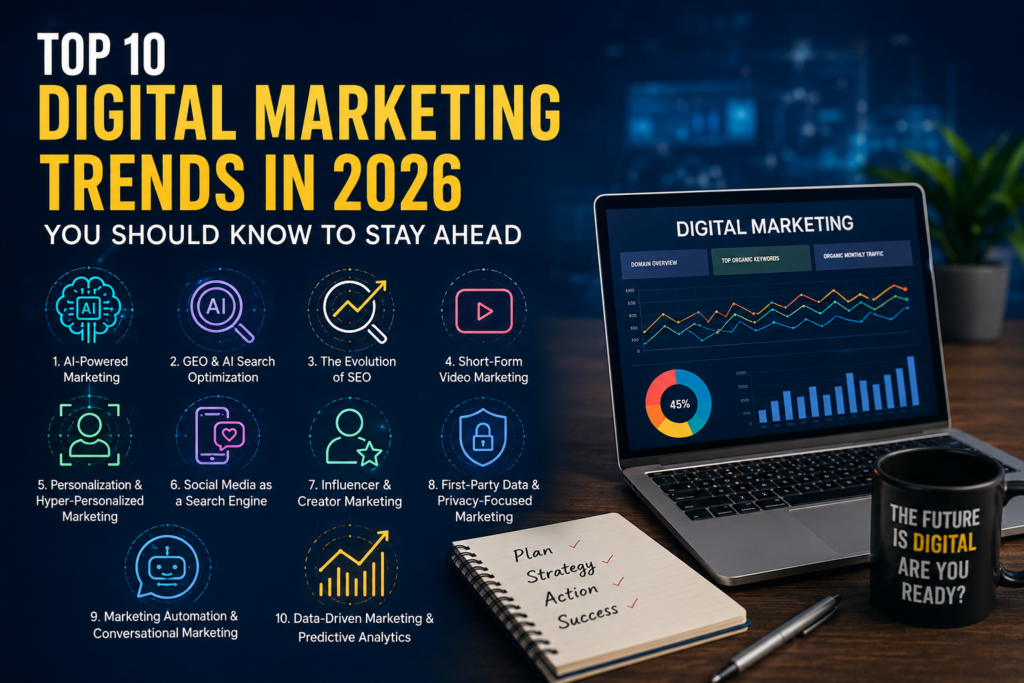
The top 10 digital marketing trends in 2026 discussed in this article are:
- AI-powered digital marketing
- GEO and AI search optimization
- The evolution of SEO
- Short-form video marketing
- Personalization and hyper-personalized marketing
- Social media as a search engine
- Influencer and creator marketing
- First-party data and privacy-focused marketing
- Marketing automation and conversational marketing
- Data-driven marketing and predictive analytics
Personal branding is another important opportunity for professionals and businesses looking to build authority online.
But remember: a trend is not automatically a strategy.
The smartest approach is to understand your audience, choose the trends that align with your goals, experiment with them and measure the results.
Digital marketing will continue changing. The marketers who stay curious, keep learning and adapt quickly will be the ones best positioned to stay ahead.
In 2026, the competitive advantage isn’t simply knowing what’s trending — it’s knowing what to do with it.
Frequently Asked Questions
What is the biggest digital marketing trend in 2026?
AI is one of the biggest forces shaping digital marketing in 2026. It is influencing content creation, personalization, advertising, automation, analytics and search. However, successful marketing still depends on strategy, creativity and understanding the customer.
Is SEO still important in 2026?
Yes. SEO remains important even as AI-powered search develops. Google states that its generative AI search experiences continue to rely on core Search quality and ranking systems, making strong SEO fundamentals relevant.
What is GEO in digital marketing?
GEO generally refers to Generative Engine Optimization. It focuses on improving the likelihood that a brand’s information and content can be discovered, understood or referenced in generative AI search experiences.
Is short-form video still effective in 2026?
Yes. Short-form video remains a major format across platforms such as Instagram, YouTube and TikTok. Current 2026 research continues to identify video as a major priority for social media marketing.
Why is personalization important in digital marketing?
Personalization helps businesses deliver more relevant experiences based on customer interests, behavior and needs. HubSpot’s 2026 research found that marketers consider AI-powered personalized content a leading trend, while a large majority surveyed reported positive results from personalized or segmented experiences.
What should businesses do first?
Businesses should start by auditing their existing marketing strategy and understanding their audience. Then they can choose one or two relevant trends—such as AI, SEO, video or automation—and test them before expanding their investment.